Erkin Zuluev
Game Designer & Writer
Projects
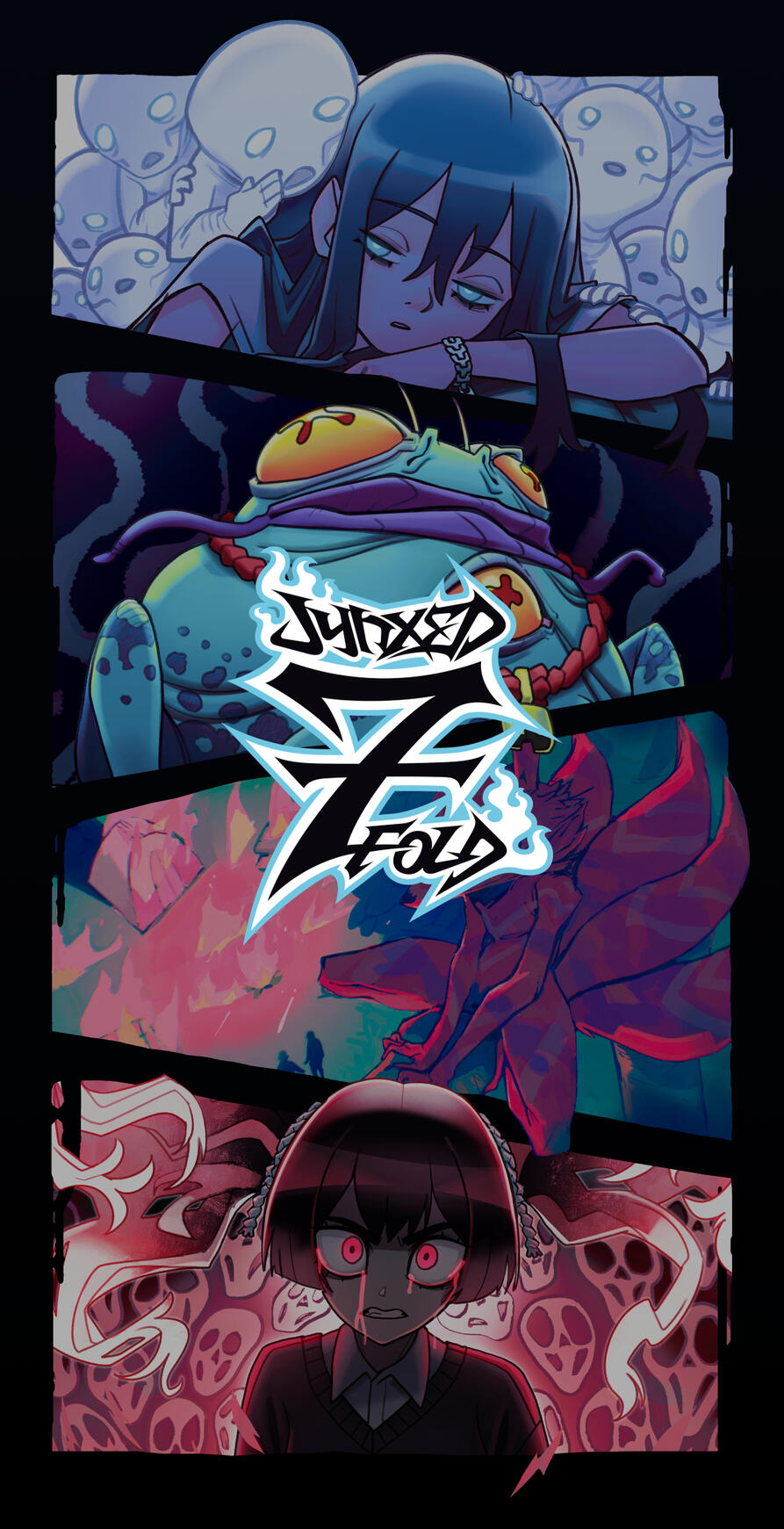
Jynxed Sevenfold – Trading Card Game
Card Game Design • Game Balance • Rules & Card Design • Playtesting
Worldbuilding • Art Direction • Promotion
Jynxed Sevenfold is an original competitive trading card game built around a central tension: the more damage a player takes, the more powerful their options become. As co-designer, I helped develop the game’s core mechanics, archetype identities, card roles, balance philosophy, worldbuilding, story premise, and player-facing rules language.My work included refining the game’s damage-and-progression system, developing faction playstyles, balancing card effects around tempo and comeback potential, coordinating visual direction for commissioned art, and supporting promotional materials as the game moved toward public release.
D&D 5e Design Work – Subclass Design & Adventure Conversion
RPG Systems Design • Subclass Design • Adventure Conversion • Encounter Design
Rules Writing • Balance & Progression • Narrative Design
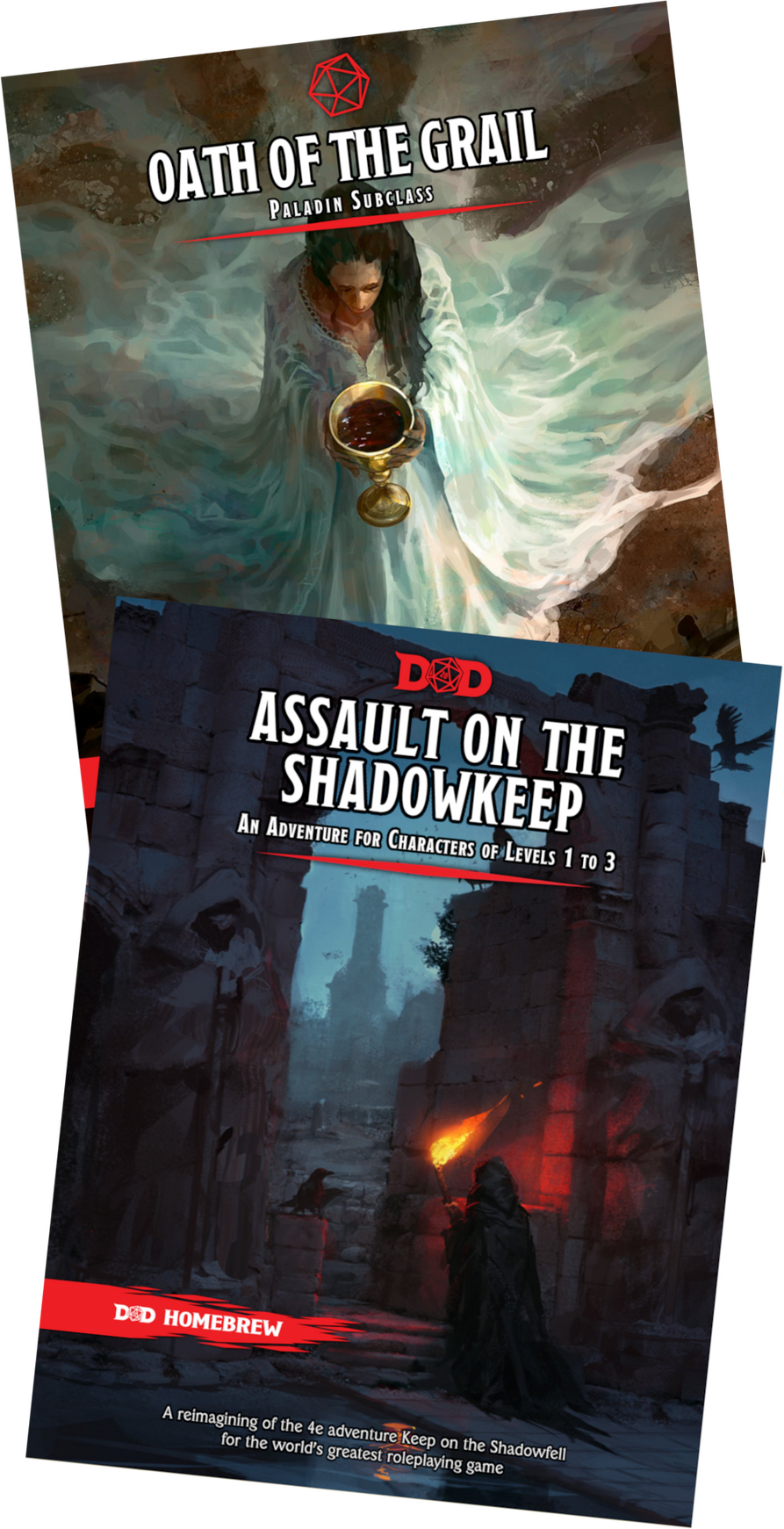
This portfolio section collects two Dungeons & Dragons 5e homebrew design samples: Oath of the Grail, a custom paladin subclass built around purity, resilience, and anti-corruption support, and Assault on the Shadowkeep, a 5e reimagining of a classic 4e adventure.Together, these projects demonstrate my ability to design within an established rules system, create mechanically coherent character progression, adapt encounters across editions, write clear GM-facing material, and preserve narrative tone while updating content for a different style of play.
Wyldeheart – Turn-Based Tactics RPG Prototype
Game Design • Turn-Based Combat • Unity Prototyping • Squad-Based Tactics
Initiative Systems • Grid Movement • Character Implementation
Wyldeheart is a work-in-progress squad-based tactics game prototype built in Unity. The project is focused on translating tabletop-inspired combat ideas into a digital tactics format, with an emphasis on grid movement, planning-phase decision-making, initiative order, and turn resolution.Current implemented systems include player-side unit selection, movement targeting, action selection, action queueing, initiative ordering, and basic turn-phase progression. The prototype is still early in development, with enemy turns, AI behavior, combat actions, UI polish, and final character presentation planned for future implementation.
Banner Art Credit: Redwall - Orlando and Matthias by sandara
Resume
Skills
Advanced:
Microsoft Office, GIMP, Creative Writing, Narrative Design, Game Design
Proficient:
Unreal Engine, Audacity, DaVinci Resolve, Screenwriting, Python, C
Languages:
English, Russian
Projects
Jynx TCG - Trading Card Game Project
Co-Creator & Designer (May 2023 - Present)
• Collaborated with co-creator to conceptualize, design, and playtest the game and its mechanics.
• Designed and playtested hundreds of unique cards.
• Currently working with co-creator to bring the game to market.Legends of the Ur Tree - Animated Fantasy Series Pitch
Creator & Writer (June 2023)
• Designed the fantasy animation pitch concept.
• Demonstrated proficiency in story structure, worldbuilding, and character design.Maxim - Original Thriller Feature Film Script
Co-Creator & Writer (April 2022)
• Collaborated with co-creator to develop the film script from first concept to final draft.
• Used the standard industry screenwriting format to deliver an engaging thriller story.The Reward of the Faerie King - Fantasy Short Story
Author (November 2022)
• Developed the narrative and characters for a fantasy short story.
• Demonstrated proficiency in creative fantasy writing.Assault on the Shadowkeep - Fan Content Adventure Path
Designer & Writer (April 2022)
• Demonstrated ability to adapt an existing design to a new rule system, keeping the spirit of the original, while introducing new and exciting elements.
• Designed, wrote, and proofread the adventure document.Oath of the Grail - Fan Content Subclass
Designer (August 2022)
• Created a new subclass option for the D&D 5th Edition paladin class.
• Demonstrated ability to design unique mechanics and content for an existing system.
Education
University of Windsor, Windsor, ON
Master’s Degree in Performance Psychology (September 2019 - December 2021)University of Toronto, Toronto, ON
Honours Bachelor of Science in Psychology and Human Biology (September 2014 - April 2018)
Experience
Hippogryff Games, Toronto, ON
Co-Founder & Game Designer (February 2024 - Present)
• Co-founded a business enterprise focused on creating tabletop game products.
• Developed and playtested engaging tabletop game content, demonstrating skills in game design and collaborative game development.
About Me
Hello, I’m Erkin and I love stories. In all my work I aim to create stories that resonate with the audience and leave a lasting impact. A great story can be told in any medium, but games, particularly videogames, interest me especially. It takes a great deal of effort and skill to deliver an experience that combines an engaging story and fun gameplay. And best games offer the players an opportunity to develop a sense of ownership and investment in the experience that is rarely matched in more traditional mediums.I strive to master the art of making great games. To that end, I've honed my skills in writing, world-building, and game design. I relish the challenge of bringing worlds to life through the fusion of storytelling and interactive design. If you're seeking a versatile game designer and writer who is passionate about the power of storytelling in games, I'd love to connect and discuss how we can collaborate to bring your vision to life.
Contact
Jynxed Sevenfold
Original Trading Card Game
Jynxed Sevenfold is an original competitive trading card game developed by Hippogryff Games. The game is built around a core design idea: while taking damage naturally brings a player closer to defeat, but it also unlocks stronger options and creates opportunities for dramatic reversals.Rather than treating damage as a purely negative state, Jynxed Sevenfold turns it into a source of escalating power. As players are pushed closer to defeat, their stronger cards and effects become easier to access, creating a constant tension between aggression, survival, tempo, and comeback potential.
Jynxed Sevenfold
Original Competitive Trading Card Game
Jynxed Sevenfold is an original competitive trading card game developed by Hippogryff Games. The game is built around an innovative central mechanic: taking damage brings a player closer to defeat, but also unlocks stronger cards and comeback opportunities.My role covered core systems design, card iteration, archetype identity, balance tuning, rules clarity, art direction, and promotional support.
Role: Co-Creator / Co-Designer
Project Type: Competitive Trading Card Game
Genre: Modern Urban Fantasy / Creature Card Battler
Focus Areas: Systems Design · Card Design · Game Balance · Rules Writing · Archetype Identity · Art Direction · Promotion
Core Design Hook: Damage as Progression
Design Goal
Create a combat system where damage creates pressure, but also gives players access to stronger options.
Design Response
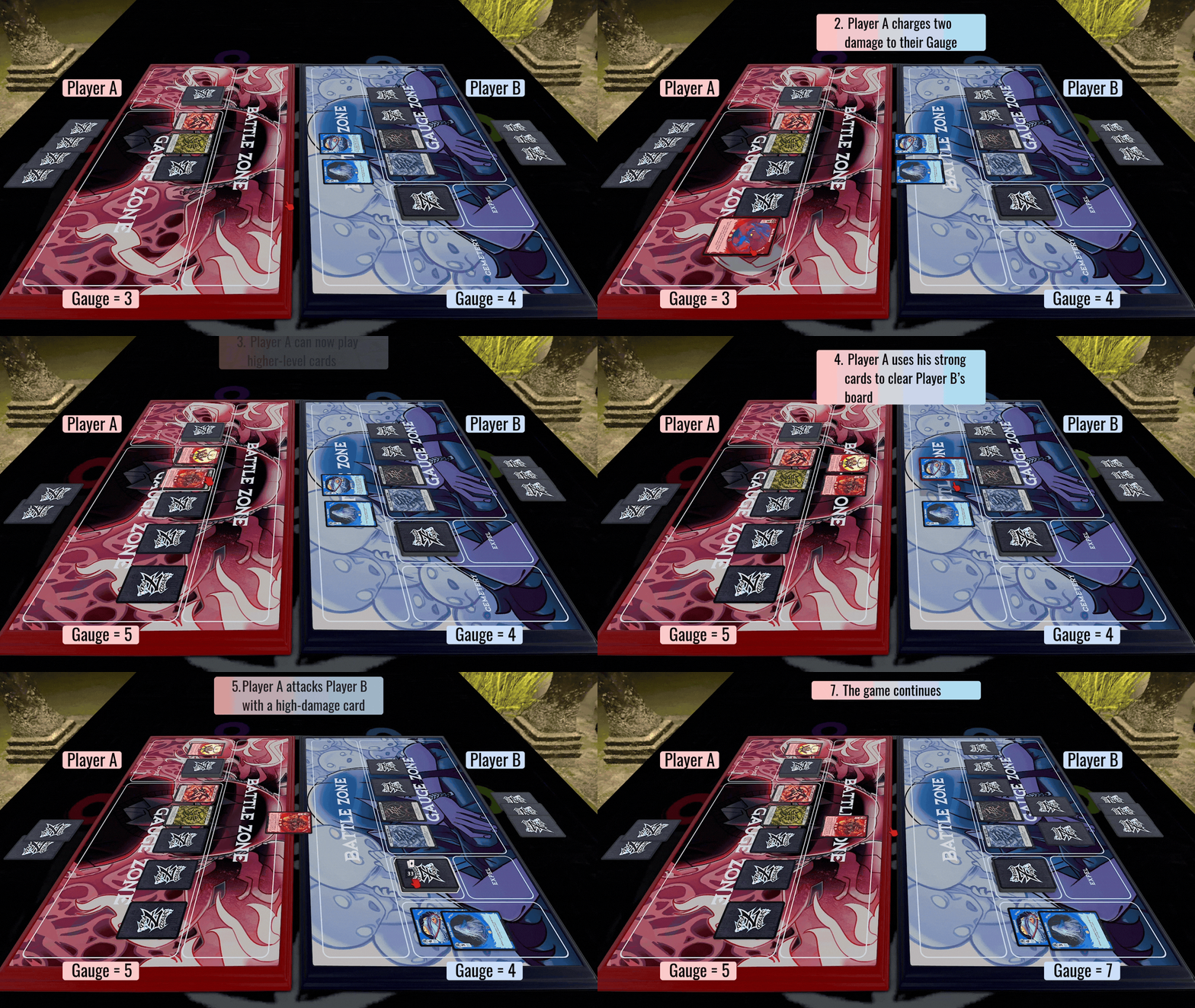
In Jynxed Sevenfold, damage is tracked through the player’s Gauge. As the Gauge rises, the player moves closer to defeat, but also gains access to higher-level cards and stronger effects.
Player Experience
Every attack becomes a risk/reward decision. Pushing the opponent closer to defeat may also give them the resources they need to turn the game around.
Design Takeaway
The game is built around controlled escalation: aggression must tempered with careful timing and restraint. Comeback potential is always an important consideration.
Design Constraint: Self-Contained Physical Play
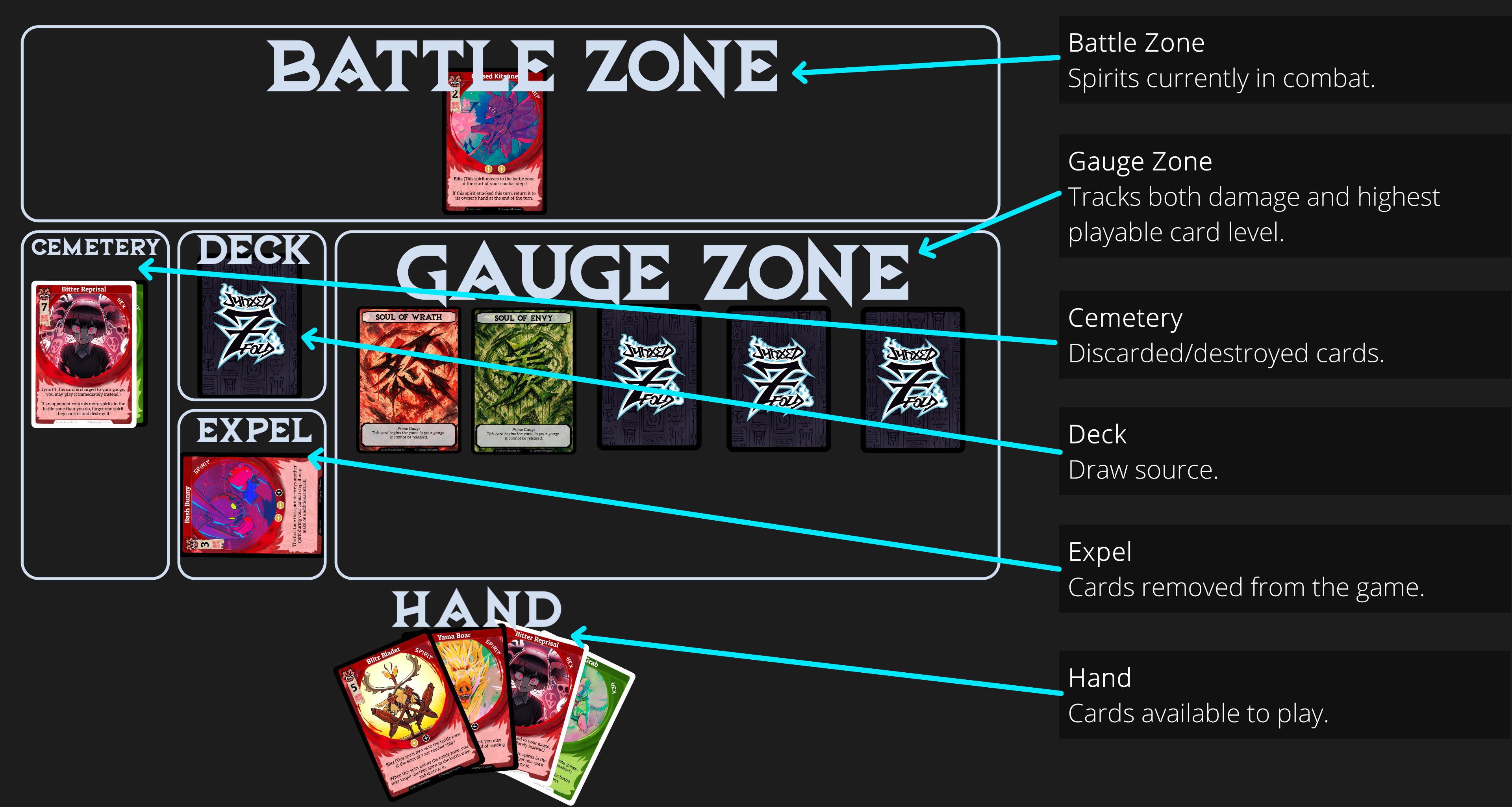
Everything the player needs to track is represented by cards on the table.
Design Goal
Create a card game that does not require outside trackers, counters, dice, apps, or health dials.
Design Response
All essential game information is tracked through the cards themselves, including damage, resource progression, and board state.
Constraint Importance
This constraint shaped the game’s usability. Every mechanic needed to be readable, teachable, and playable at the table without adding extra bookkeeping.
Archetype Design: Seven Emotions, Seven Playstyles
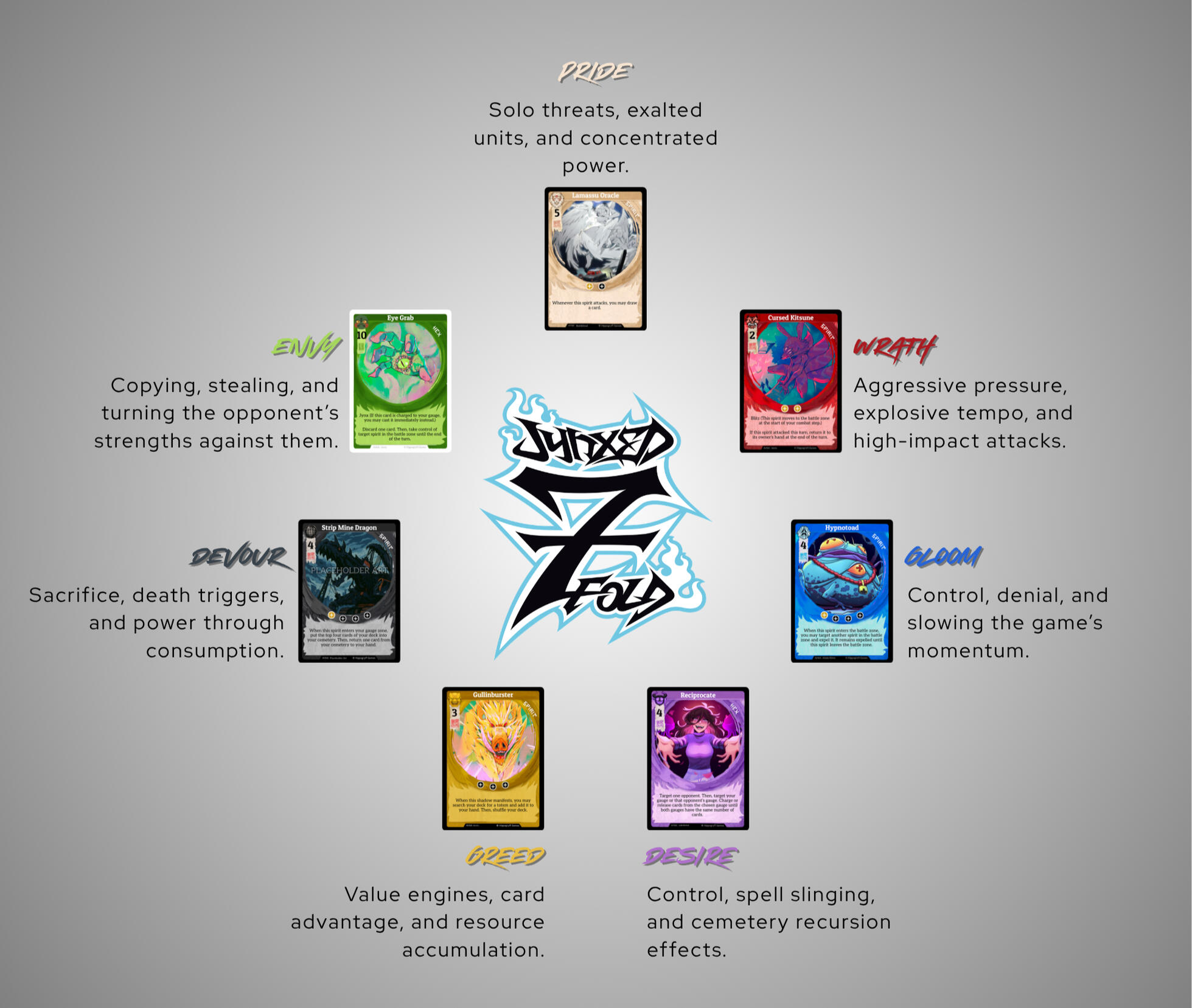
Rather than building Jynxed Sevenfold around the classic elemental model of fire, water, earth, and air that is often used in other TCGs, we wanted each archetype to grow out of human emotion. The seven archetypes were inspired by the seven deadly sins, but reimagined through the game’s world as magical expressions of emotion given form.Each archetype needed to answer two design questions: what emotion does this represent, and what should that emotion feel like in play?


Design Takeaway
It was important to give each archetype a different and meaningful set of mechanics which could make each playstyle feel emotionally aligned with its theme.
Card Iteration: From Ideas to Playable Designs
A major part of development involved revising cards across multiple versions in response to playtesting, balance concerns, rules clarity, and archetype identity.Rather than showing every change, this section highlights three focused examples:


Rules Clarity: Hypnotoad
Problem
Early versions modified the opponent’s Gauge value, creating exceptions to one of the game’s most important core systems.
Design Response
We moved the card away from abstract resource manipulation and toward a visible board interaction.
Current Direction
Hypnotoad now temporarily expels another spirit when it enters the battle zone, making the effect easier to understand, easier to resolve, and more satisfying in play.
Takeaway
If rules or gameplay clarity keeps feeling out of reach, then perhaps the issue is with the core design itself.


Balance: Blood Summoning
Problem
Early versions were too situational. The card often required too many conditions to line up before it felt worth playing.
Design Response
We shifted the card toward a cleaner resurrection effect that better supported Wrath’s aggressive identity.
Current Direction
Blood Summoning now brings back a spirit for one powerful turn, then destroys it at the end of the turn.
Takeaway
A key issue with balance is making sure all cards are exciting enough to be worth playing while still being aligned with the right playstyle identity.


Archetype Identity: Thousand Tears Dragon
Problem
Early Gloom boss monsters leaned too heavily on familiar control-card tropes and did not fully express what made Gloom unique.
Design Response
We redesigned the boss around Gloom’s deeper themes: grief, memory, stagnation, and drawing power from emotional weight.
Current Direction
Thousand Tears Dragon exchanges the cards in your hand with the cards in your free Gauge, turning the game’s damage/progression system into an expression of Gloom’s identity.
Takeaway
The final design worked because it tied Gloom’s theme directly to Jynxed Sevenfold’s core resource system..
Art Direction & Creative Briefs: Communicating Visual Identity to Artists
A major part of my work involved helping translate abstract card concepts into visual direction for commissioned card art.For each major art brief, I helped define the piece's mood, emotional theme, creature or effect concept, visual references, and archetype identity. This included creating moodboards, gathering reference images, writing art direction notes, and clarifying what the illustration needed to communicate in a single card image.
Design Goal
Help artists understand what to draw, as well as what the card art needed to feel like.
Skills Demonstrated
Creative direction · Visual communication · Moodboard development · Artist collaboration · Brief writing · Theme-to-visual translation · Feedback and revision
Example 1: Binding Rebirth
Design Need
Communicate an aggressive, unstable spiritual manifestation fuelled by the caster's pain and spilled blood.


Example 2: Golden Bristles
Design Need
Communicate a high-energy, dynamic image of an opulent and showy mythical creature.


Example 2: Eye Grab
Design Need
Communicate a creepy-looking, insidious spell effect centred on stealing the opponent's creatures.


Design Takeaway
These briefs demonstrate my ability to translate game mechanics, archetype identity, and worldbuilding into actionable creative direction for artists.Good art direction is about giving artists enough structure, context, and emotional clarity to make strong creative decisions that result in an excellent illustration.
What I Learned
Working on Jynxed Sevenfold strengthened my understanding of how interconnected tabletop systems are. A change to one card can affect archetype identity, matchup dynamics, game pacing, rules clarity, and player experience.The project also taught me the importance of designing within physical constraints. In a card game, mechanics need to be readable, trackable, teachable, and satisfying to play at the table.Most importantly, I learned that strong design depends on communication: clear rules for players, clear systems for playtesters, and clear creative direction for artists.
D&D 5e Design Work
Subclass Design & Adventure Conversion
This section showcases two Dungeons & Dragons 5e homebrew design projects: Oath of the Grail, a custom paladin subclass, and Assault on the Shadowkeep, an unofficial 5e reimagining of the 4th Edition adventure Keep on the Shadowfell.Together, these projects demonstrate RPG systems design within an existing rules framework: class progression, encounter structure, narrative adaptation, GM-facing clarity, and map-driven adventure design.
Oath of the Grail


Subclass Identity & Progression
Design Goal
Create a paladin subclass that expresses the fantasy of a Grail Knight from Arthurian legend: a warrior defined by purity, resilience, and resistance to corruption.Design Response
The subclass was built around endurance, protection, cleansing, and moral clarity. Its mechanics resist poison, charm, psychic influence, curses, and other corrupting forces, while supporting a playstyle focused on staying in the fight and protecting allies.Progression Arc
The subclass grows from personal resilience into party-wide protection:3rd Level: Personal sustain and resistance to manipulation
7th Level: Protective anti-poison aura
15th Level: Shared resilience for nearby allies
20th Level: Angel-like capstone with radiant battlefield presenceDesign Takeaway
The Grail Knight subclass works because the mechanics reinforce the theme at every stage of progression. The subclass lets the player embody the fantasy of an Arthurian knight by allowing them to resist corruption and inspire the rest of the party to fight against it.
Assault on the Shadowkeep
Assault on the Shadowkeep - Complete Adventure; 64 page document (PDF)


Adventure Conversion & Encounter Design
Design Goal
Rework a classic 4e adventure into a stronger 5e experience through clearer objectives, better pacing, and more usable DM-facing encounter design.
Case Study – Area 16: Profane Gate Boss Fight
The final boss encounter serves as the clearest example of my redesign philosophy. I reframed the context of the main antagonist's motivations, streamlined the journey to get to the climactic battle, and redesigned the encounter to be easily understandable and narratively consistent.
Encounter Objective
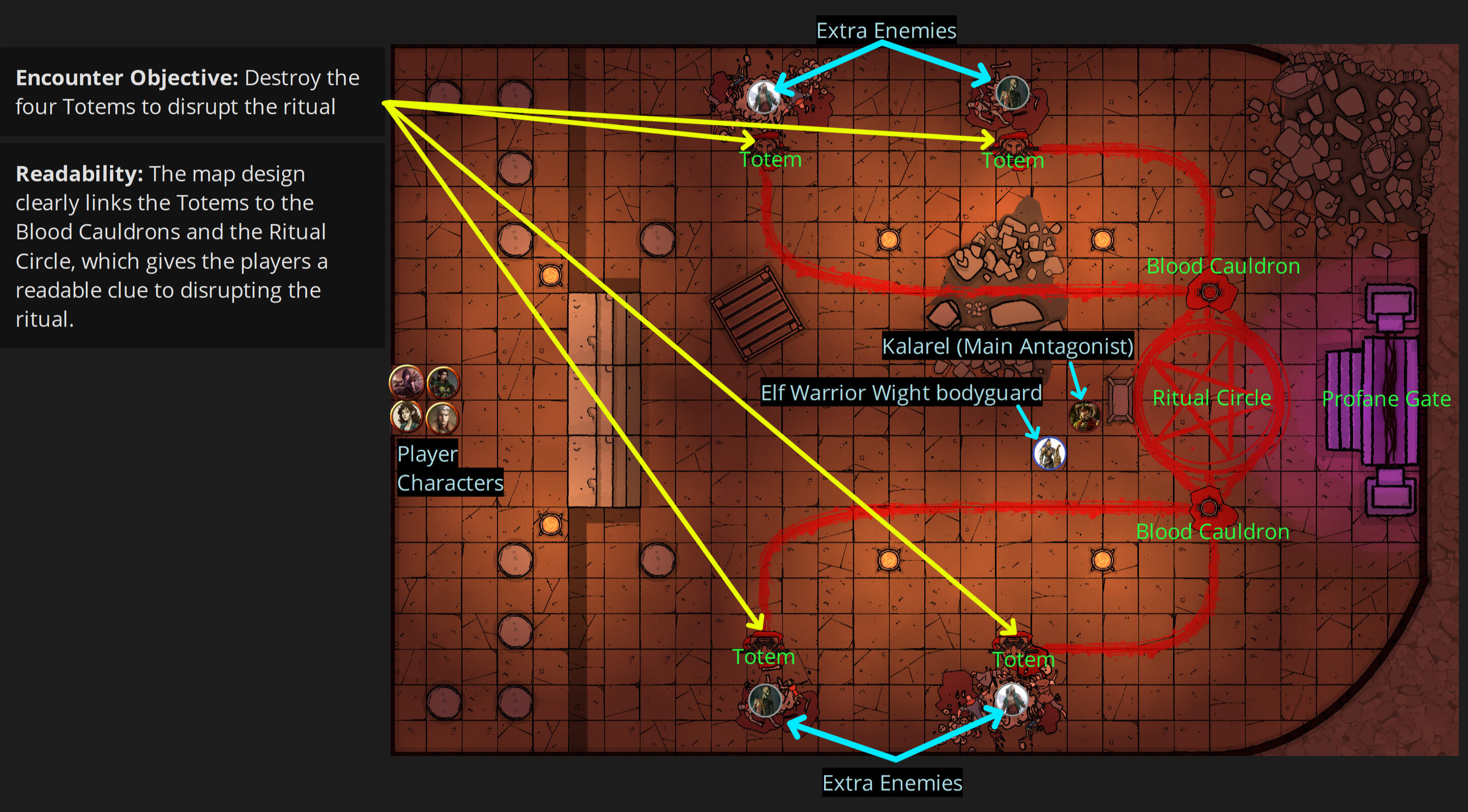
Instead of a straightforward boss fight, the encounter centers on disrupting main antagonist’s ritual by destroying the four Totems feeding it. The room’s layout helps communicate this visually: the Totems feed the Blood Cauldrons, which in turn feed the Ritual Circle that powers the Profane Gate. This makes the objective readable and gives players more meaningful choices during combat.
Dynamic Difficulty
The encounter also gives the DM flexible, in-universe ways to adjust challenge during play. If the party is performing well, Kalarel can raise more undead from the Totem-powered corpse piles, cast more offensive spells, or send his Elf Warrior Wight bodyguard into the fray. If the party is struggling, the DM can reduce enemy pressure, keep the Wight in a more defensive role, or scale back Kalarel’s offensive output.
Diegetic Safety Net
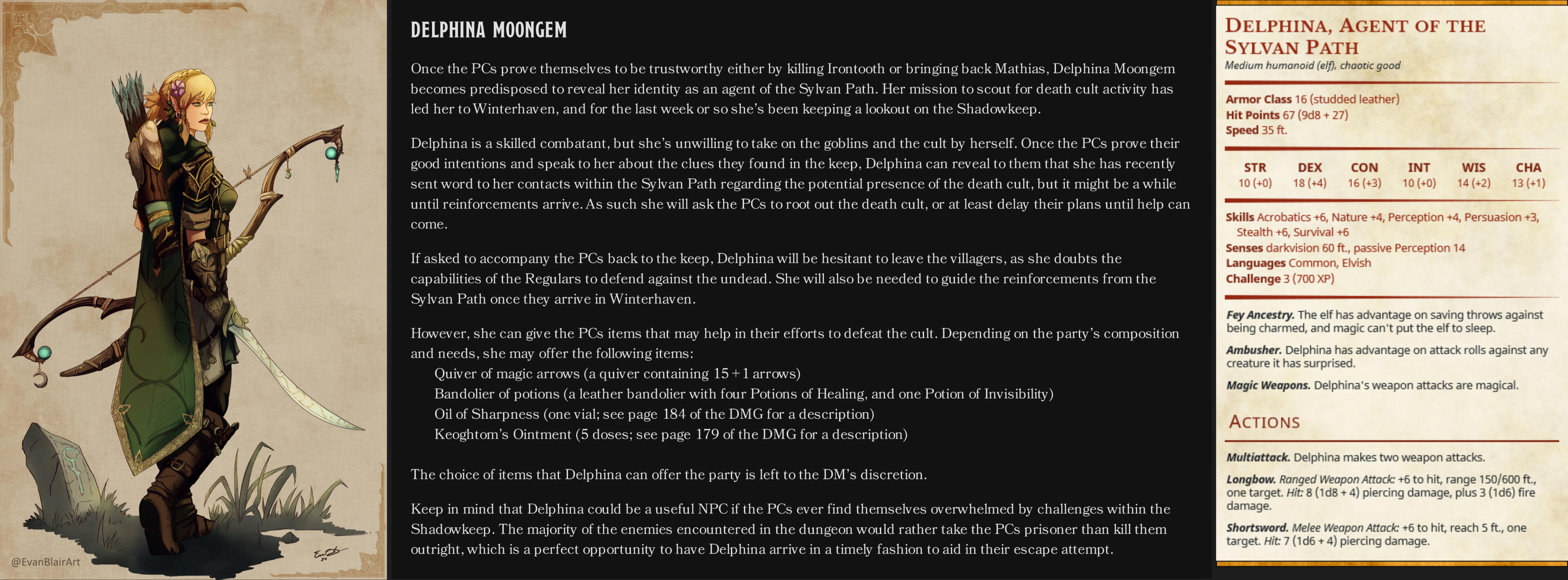
To support low-level 5e play, I also built in a narrative fail-safe through Delphina Moongem, an NPC introduced earlier in the adventure as a travelling flower saleswoman and secret agent of the Sylvan Path. If needed, she can arrive as timely reinforcement, giving the DM a way to preserve game momentum without breaking immersion.
What I Learned
These projects taught me how to design original RPG content within an established rules system. For Oath of the Grail, that meant building subclass features that fit 5e’s progression structure while reinforcing a clear fantasy and playstyle.When it comes to Assault on the Shadowkeep, it meant adapting existing source material while preserving the spirit of the original, and introducing new narrative and gameplay elements that translate into a smooth and coherent 5e experience.Across both projects, I learned how important clarity is in tabletop design. When writing player-facing abilities or DM-facing encounters, the content needs to be precise, readable, and easy for someone else to interpret at the table.
Wyldeheart
Turn-Based Tactics Game Prototype
Wyldeheart is a work-in-progress turn-based tactics game prototype built in Unity. The project began as a way to explore tactical combat, party-based decision-making, and animal-folk fantasy through a videogame format.
Core Design Goal: Variable Combat Initiative
Design Problem
In many turn-based tactics games, initiative is either fixed at the start of combat or divided into predictable player/enemy turns. This makes turn order easy to read, but it can also separate initiative from the player’s moment-to-moment tactical choices.Solution
In Wyldeheart, initiative is determined by the actions units choose during the planning phase. The player assigns actions to multiple units, then those actions are sorted into an initiative queue based on speed.Result
Timing becomes part of the strategy. Fast actions resolve earlier and offer reliability, positioning, or disruption. Slower actions can deliver stronger effects, but carry the risk of resolving after the battlefield has changed.
Combat Flow Mockup
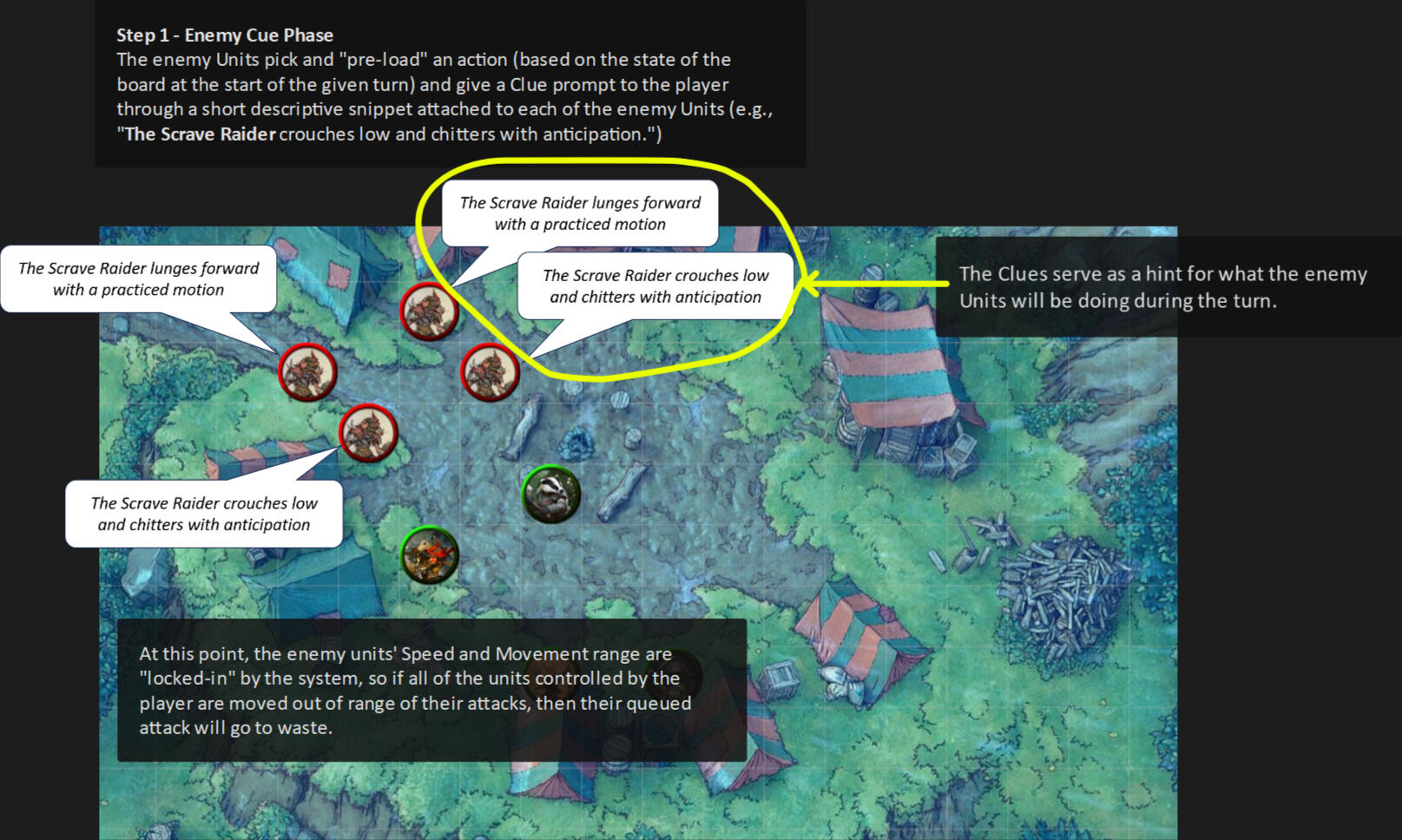
Step 1 - Enemy Cue Phase
The enemy units queue their actions and display a Clue prompt.
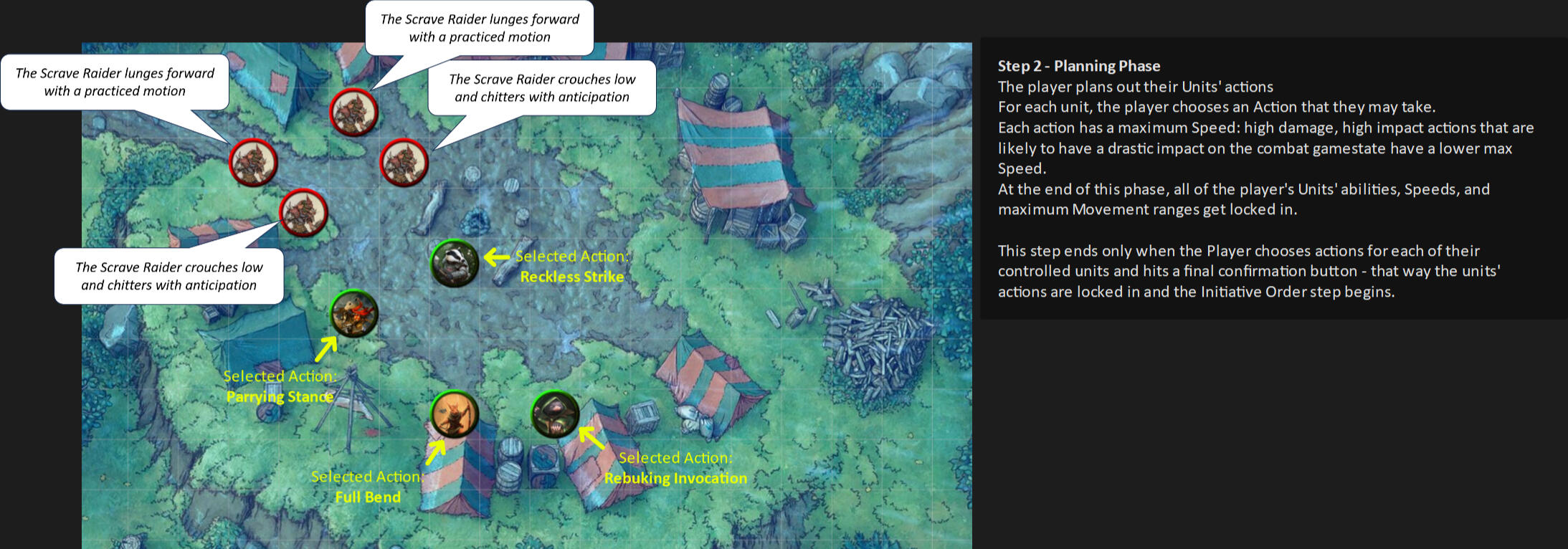
Step 2 - Planning Phase
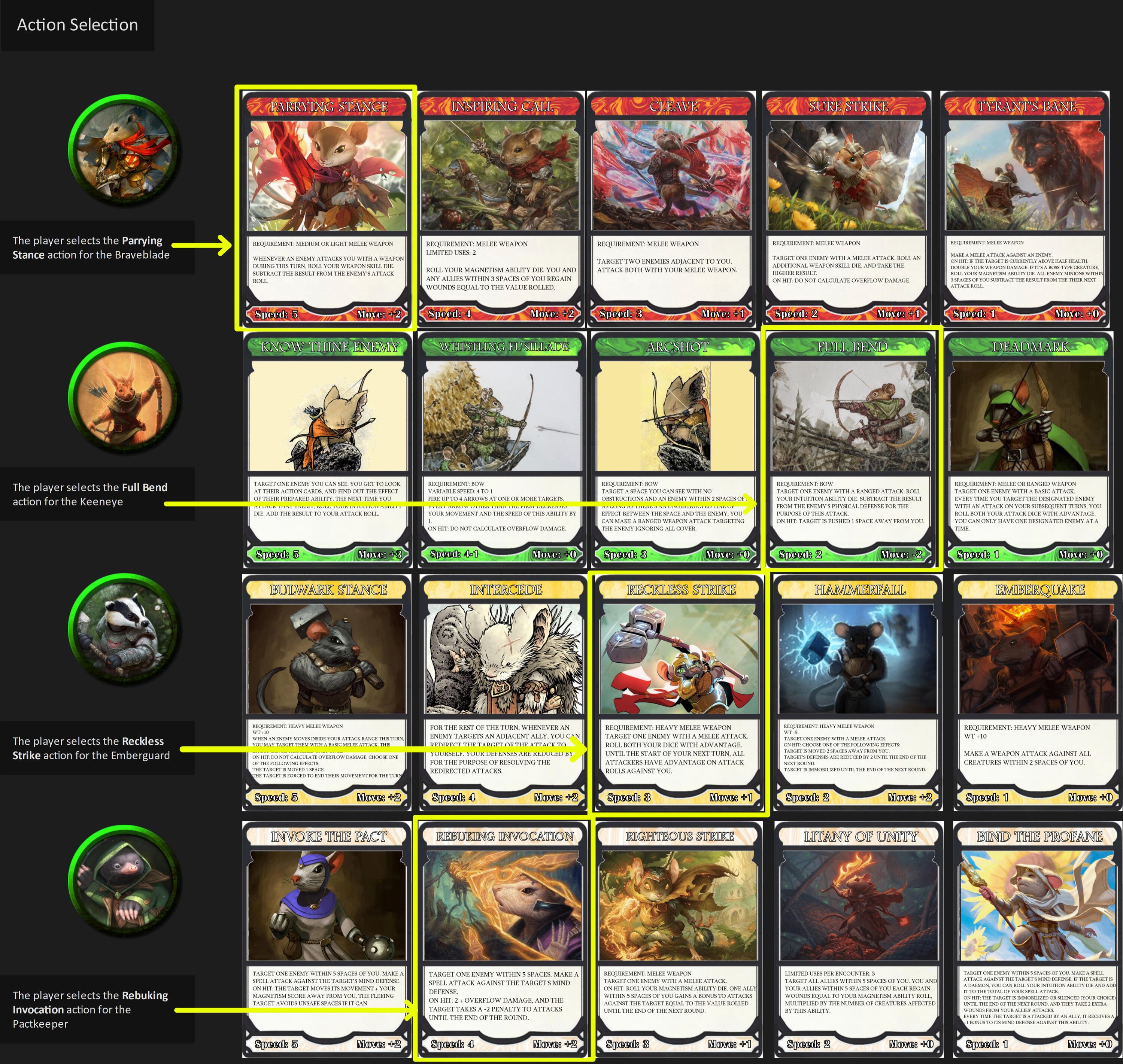
The player selects units and assigns actions. Actions are queued rather than immediately resolved.
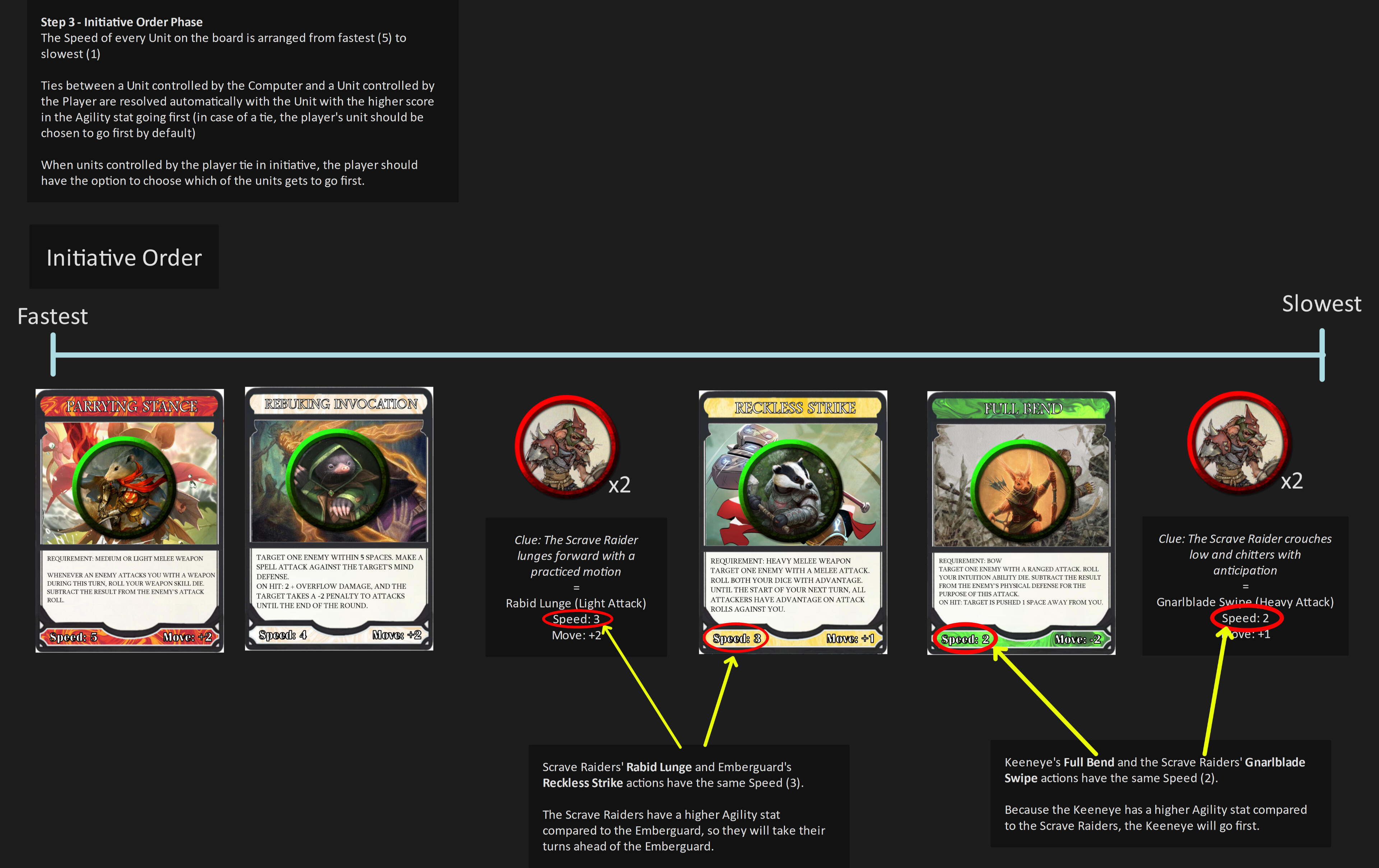
Step 3 - Initiative Order Phase
Queued actions are ordered based on initiative logic, creating a visible sequence for action resolution.
Step 4 - Action Resolution Phase
Units execute their queued actions in order, moving across the grid and updating the battlefield state.
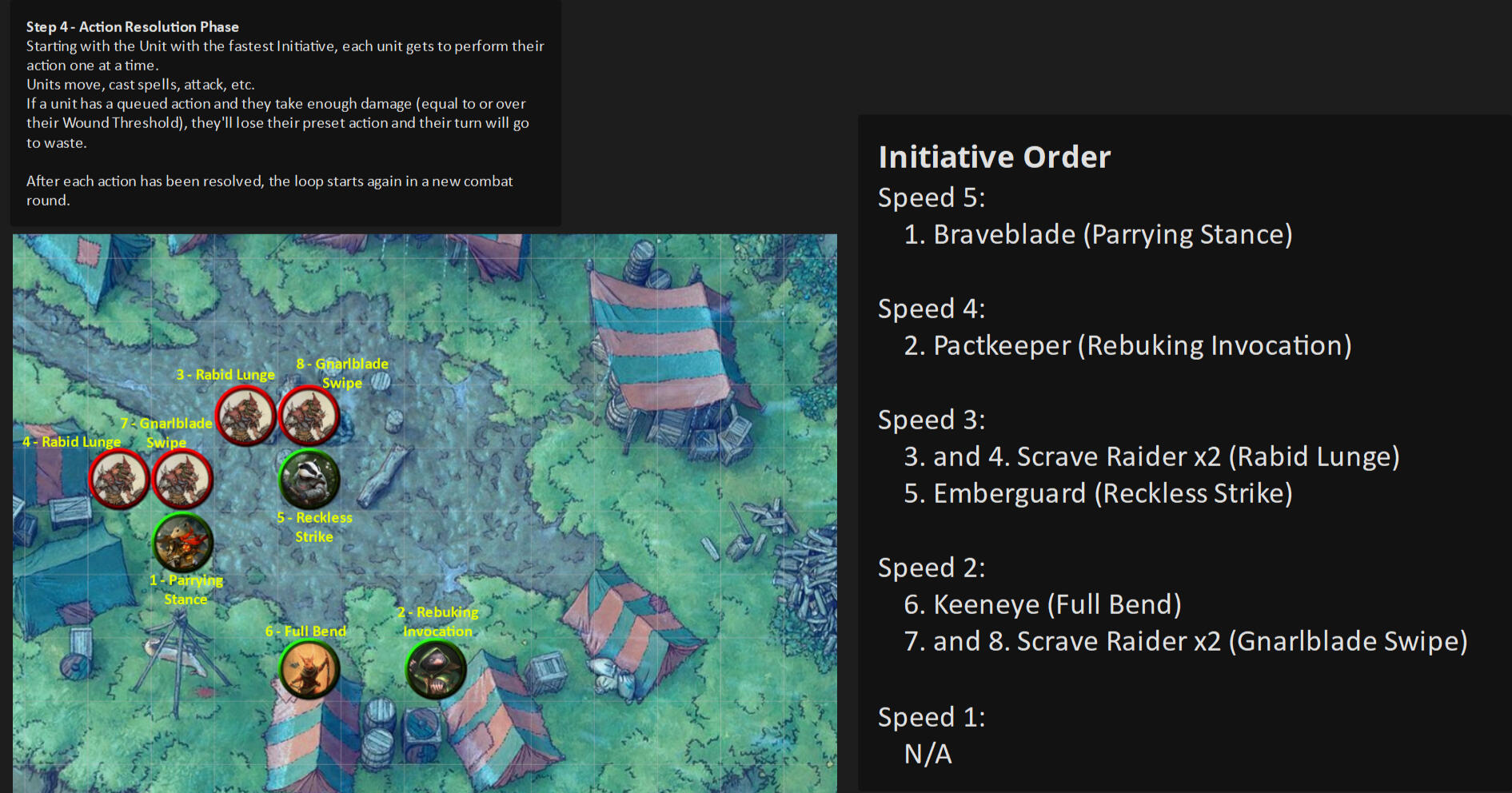
This structure is intended to support future tactical depth, including enemy actions, interrupted plans, speed-based abilities, delayed attacks, and class-specific combat roles.The visuals above were created as a low-fidelity mock-up of the intended combat experience. They're meant to demonstrate the turn structure, tactical perspective, and action-selection flow rather than represent final art, UI, or production visuals.
Current Implementation
The current playable systems include player unit selection, movement targeting, valid movement tile highlighting, action queueing, initiative ordering, and basic movement resolution.The prototype does not yet include enemy turns, enemy AI, polished combat abilities, final UI, or finished character visuals. Those are planned next steps. At this stage, the focus has been on proving out the underlying combat flow before investing heavily in presentation.
What I Learned
Wyldeheart taught me that designing a tactical combat system for a videogame is different from designing one for tabletop play. A tabletop initiative rule can rely on players and a GM to interpret edge cases, but a digital version needs every state, input, queue update, and timing rule to be clearly defined.Implementing variable initiative in Unity pushed me to think about design as both a player-facing experience and a technical structure. The system needed to be tactically interesting, but also readable, responsive, and clear enough for players to understand why each action resolves when it does.
Turn-Based Tactics Game Prototype
Wyldeheart is a work-in-progress turn-based tactics game prototype built in Unity. The project began as a way to explore tactical combat, party-based decision-making, and animal-folk fantasy through a videogame format.The current prototype is focused on the foundations of turn structure: selecting units, choosing actions, queueing those actions, resolving initiative order, and moving through the phases of a tactical encounter. While the project is still visually rough, the design goal is to build a flexible combat framework that can eventually support class abilities, enemy behavior, character progression, and encounter design.
Project Snapshot
Project Type: Turn-Based Tactics Game Prototype
Engine: Unity
Current Status: Work in Progress
Design Focus: Turn structure, planning phase, action queueing, grid movement, initiative order, and tactical combat flow
My Contributions
• Designed and implemented the player-side turn structure
• Built a planning phase where units can select and queue actions before resolution
• Implemented grid-based movement and valid-tile selection
• Created a basic initiative queue to determine action order
• Developed the foundation for unit selection, action selection, and movement execution
• Built the project with future support for enemy turns, AI behavior, tactical abilities, and encounter design
• Began character implementation work, including rigging a mouse warrior model for future prototype use
Visual Development
Because the project is still early, most visuals are currently placeholder. The portfolio presentation focuses on the systems being tested rather than final art quality.Visual materials for this page include annotated Unity screenshots, turn-structure diagrams, prototype clips, and in-progress character implementation screenshots. These materials are meant to show how the system works and how the project is developing over time.
Legends of the Ur Tree
Legends of the Ur Tree is an animated fantasy adventure series concept created for OIAF's 2023 Pitch THIS! contest. The series is aimed at children and teens.
The story focuses on the adventures of a group of fantastical beings – Aurika, the plant-loving gnome, and three goblin brothers: the big and slothful Tab; the anxious overthinker Ker; and the ambitious Zar. Aurika leads the brothers on a journey across a devastated fantasy world to discover the mystery behind a unique magic flower that was left to her by her grandfather. Travelling by a magic hot air balloon, the friends come face to face with dragons, explore the ruins of ancient castles, and meet other inhabitants of the land.The friends discover that in order for goodwill and chill vibes to survive, and even thrive in the ruins of the devastated world, they must meet each challenge with a hopeful and resilient attitude.Complete Pitch Document - 18 page document (PDF)


Maxim
Maxim is an original horror thriller feature film script written by Erkin Zuluev and Nadya Semenova. The script has been submitted to The TITAN (2022) Screenwriting Contest and 2022 ScreenCraft Feature Competition.The story follows a high school student who's been entangled in a tragic chain of events set off by the manifestation of her boyfriend's hereditary curse, and her unexpected pregnancy.Script Excerpt - 10 page document (PDF)
The Reward of the Faerie King
The Reward of the Faerie King is an original fantasy short story following the adventures of an assassin rat named Flit. In this venture, Flit has to infiltrate a wizard's tower in order to complete a task at the behest of a powerful and capricious Faerie King.The Reward of the Faerie King - 12 page document (PDF)
Assault on the Shadowkeep
Assault on the Shadowkeep is a D&D 5th Edition re-imagining of the classic D&D 4e adventure Keep on the Shadowfell. The original adventure has been converted to be compatible with D&D 5th Edition rules, introduces new story elements, and overhauls many parts of the original dungeon.Assault on the Shadowkeep is unofficial Fan Content permitted under the Fan Content Policy. Not approved/endorsed by Wizards. Portions of the materials used are property of Wizards of the Coast.


Assault on the Shadowkeep - Complete Adventure; 64 page document (PDF)
Oath of the Grail
Oath of the Grail is a D&D 5th Edition fan content paladin subclass designed to embody the ideals of the chivalric hero as described in Arthurian legends of Sir Percival and Sir Galahad.


Oath of the Grail - 2 page document (PDF)